In a Numberphile interview posted on October 15, Terence Tao praised OpenAI’s partial result on the Riemann hypothesis and then said:
I’m sure [the AI companies have] secretly devoted much more time to the Riemann hypothesis than what they’ve disclosed. And they couldn’t touch it. I mean, something beyond current AI is needed. So maybe some combination of humans and AIs in 2050 or something will make further progress. Who knows?
I watched the full interview at the time. I would watch any interview with Tao (and you should too). He has so far been helping everyone navigate and reflect on this breakneck pace of AI advancement that we suddenly found ourselves in. He also describes himself as a generalist (which is why I think his real analysis volumes are so great as teaching material compared to the other standard texts on the subject). So, he is one of the best people the math community currently has to steer their ship.
But on November 20, Levent Alpöge of Anthropic posted a four-page love letter to Claude that says: “I believe I have, working with Claude, discovered a proof of the Riemann Hypothesis.” The proof is 17 million lines of Lean, a language in which a computer checks every step. The idea is that if the code compiles, every step is right, and people only have to check that it proves the right statement. A day later the organizations behind Lean and its math library, the Lean FRO and the Mathlib Initiative, said in a joint statement that they had “full confidence” it is correct. No person has read the whole argument yet. In fact, the Association for Human Mathematics stated that “no human being can reasonably claim to be responsible for, or even to understand, such a document,” and urged mathematicians to build a future “free from dependence on AI models and their corporate owners.” Alpöge writes that he has not mastered the mathematics around it. He says the fully written-out version ran past 250,000 pages and calls it unreadable, so he posted only the Lean.
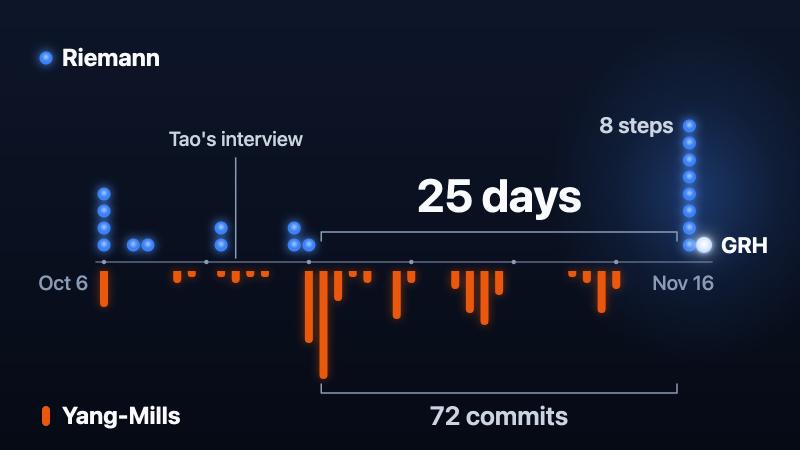
The note also has a rough timeline of the argument, compiled by Claude. It lists 20 steps, each with a date. They fall on only 8 of the 42 days between October 6 and November 16, and 8 of the 20 are dated November 15, the day before the result.
The note does not say what happened on the other 34 days, but I checked the public record. Alpöge was busy with other problems. On October 6, the day of the first step, he and Ethan Sussman of Northwestern went public with a project to get Claude to construct Yang-Mills theory, which is part of another Millennium Prize problem. OpenAI announced a proof of that part on October 26. During the longest gap between Riemann steps, 25 days, the project’s repository received 72 commits, nearly all of them Sussman’s. Alpöge added notes to it himself on October 16 and November 10. He may have also been devoting a significant amount of his time to Riemann during those 25 days, running into dead ends or actually making progress in the right direction without “committing” his work until November 15. On November 20 he also released two papers on fluid equations with other mathematicians.
So while Alpöge was “proving” the Riemann hypothesis, he was multitasking with other projects. He writes that the problem “would fall given enough all-nighters and physical toll,” but that was over six weeks, not years. This is unlike the focus and tenacity that we knew such a proof required before. Andrew Wiles gave Fermat’s Last Theorem all of his research time for more than six years, in near-total secrecy. Grigori Perelman turned down jobs at Princeton and Stanford for a research-only post in St. Petersburg to work on the Poincaré conjecture.
In Alpöge’s case, my guess is that the human’s attention was still the limit. Another significant proof in the future may not even require a human at all. A result with no human in the loop has already happened on another problem recently. Anthropic’s paper on a 3-SAT result, which I come back to below, says the core algorithm “was found on October 16 by an internal Claude research model with 14M output tokens and no human input.”
Tao has encouraged mathematicians to adopt AI tools for some years now. In the Numberphile interview he said he thought no single mathematician alive would have come up with OpenAI’s technique. If the smartest person in the world, in his own field, can be this wrong about AI, then everybody should be actively preparing for whatever they believe about AI to turn out incredibly wrong, incredibly quickly.
Part of our reluctance to accept what AI can do is very human. We do not want AI to be able to do most or all of what we value and praise in ourselves, and to do it better than we can. In February I wrote “AI Coding Black Hole” about the same reluctance in programmers, who define themselves by the code they can produce by hand. Tao describes the mathematicians’ reluctance himself. Early in the interview he says “we are seeing the end of the romantic era of mathematics, the age of heroes.” He says “it is sad,” and that mathematicians are entering “rather unwillingly” a new era “where exciting new things are possible but some things are being lost.” I guess that even when we can see what AI is about to do, most of us would still like to believe there is something it can’t solve.
Other mathematicians have said something similar. For the last year and a half, 3Blue1Brown has been asking mathematicians how they would feel if AI produced a Lean-verified proof of the Riemann hypothesis that was incomprehensible to humans, and it posted their answers within two days of Alpöge’s note. In August 2025, Ken Ono of the University of Virginia said, “As a romantic in terms of mathematics, what you describe would be horrible. I would want a human being involved in the proof.” This September, Ankur Moitra of MIT said some kinds of problem solving were going to get cheaper, then brought up Riemann and said, “maybe these amazing landmark problems will all still survive, who knows? Could be wrong about that.” Some others were hoping for it. In August 2025, Johannes Schmitt of ETH Zurich said, “I’m really hoping that at some point DeepMind just comes out and says, hey, our model proved the Riemann hypothesis. Here’s the Lean proof.”
It’s incredible to me that the only hard limit we may be able to name on what AI can prove is Gödel’s incompleteness theorem. In 1931 Kurt Gödel proved that any consistent set of axioms you can write down, if it is strong enough for arithmetic, leaves some statements it can neither prove nor disprove. The continuum hypothesis is the best-known example. Gödel and Paul Cohen showed that the standard axioms of set theory cannot settle it, so no AI will ever prove it from those axioms. Another example that computer scientists are familiar with is the halting problem. In 1936 Alan Turing proved that no program can tell, for every program, whether it will ever stop. It follows that for any such set of axioms, some program runs forever and the axioms cannot prove that it does. Outside mathematics there are practical obstacles. Most work cannot be checked by a program the way Lean checks a proof. But I know of no result that says AI has to stop short of what people can do.
Is P vs NP next? Riemann is already the second Millennium Prize problem to fall to AI since September, after OpenAI’s Lean-checked answer to Navier-Stokes. Gödel asked a version of P vs NP, a bounded form of the Entscheidungsproblem, in a 1956 letter to John von Neumann. If a machine could find proofs about as fast as it could check them, he wrote, “the mental work of a mathematician concerning Yes-or-No questions could be completely replaced by a machine.” Most “human” researchers believe P ≠ NP, which would mean no machine can find every proof that fast.
Yet, there has also been a recent surprising result that is some evidence for P = NP. On October 26, OpenAI announced that its AI had proved the Exponential Time Hypothesis false, and hours later Anthropic posted its own proof, found by Claude. The hypothesis says that 3-SAT, a textbook hard problem, needs exponential time. That is a stronger claim than P ≠ NP, so refuting it does not show P = NP, and both proofs are still under independent review. The complexity theorist Scott Aaronson said the news raised his probability of P = NP from 3% to 5%.
We are all trying to digest that what made us valuable is suddenly not so special and not so expensive. Tao says mathematics is “transitioning from an era of proof scarcity to proof abundance.” Proofs were worth a career partly because they were scarce, and the same is true of most things people get paid for in any white-collar job. If your livelihood depends on AI not reaching some threshold, the best thing you can do right now is assume it gets there soon. What would you do if it did?
It looks like machines will do the mental work that we thought made us humans unique. This is often a hard pill for me to swallow too. Just a year ago my belief was that I would always write the important parts of my code myself and that I would need to review every AI pull request. Both turned out to be wrong in less than six months. But we have remarkable adaptation skills, which makes me hopeful that after this interim period we will be in a world where knowledge workers still have work to do and still have their dignity and value.